


When Analytics Environments Reach Their Limits
Clinical trial data passes through various systems, tools, and validation steps before it is ready for analysis and regulatory processes. End-to-end clinical data management keeps data, processes, and responsibilities traceably organized. HMS supports life sciences companies modernizing and extending their existing data and analytics environments.
Typical challenges include:
- Analytics environments must support open-source tools in a way that complies with regulations.
- Existing systems do not allow for scaling, automation, or collaboration.
- Manual and time-consuming validation steps need to be automated.
- Analytics workflows are fragmented or only partially auditable.
- User interfaces must support the specific needs of analysts and other user groups.
To meet these requirements, HMS develops customized solutions that strengthen core functional areas without requiring platforms to be completely rebuilt.
Our Range of Services
From Package to Platform
HMS supports life sciences organizations in setting up and operating customized statistical computing environments. This includes individual components as well as complete and validated platforms. Our services can be used individually or combined as needed.
How we support your workflow
HMS aligns its services with the workflows and validation requirements of modern analytics environments. Individual service modules can support specific SCE functions or be combined across the platform lifecycle. This allows HMS to support individual components as well as broader platform initiatives.
Statistical Computing Environments
Why a Modern SCE Is Essential
Fragmented systems and outdated tools slow down the management and analysis of clinical trial data. This directly impacts the creation of reports and their submission to regulatory authorities. A modern SCE enables scalable and reproducible analytics that meet regulatory requirements and support faster time to market.
During a 30-minute discovery call, we’ll assess how your current analytics workflows are set up and identify where support from HMS can deliver immediate benefits.
HMS’s services are based on the core functions of a modern Statistical Computing Environment (SCE). Even if you’re not building a complete platform today, we ensure that individual components are designed to be scalable, traceable, and compliant with regulations.
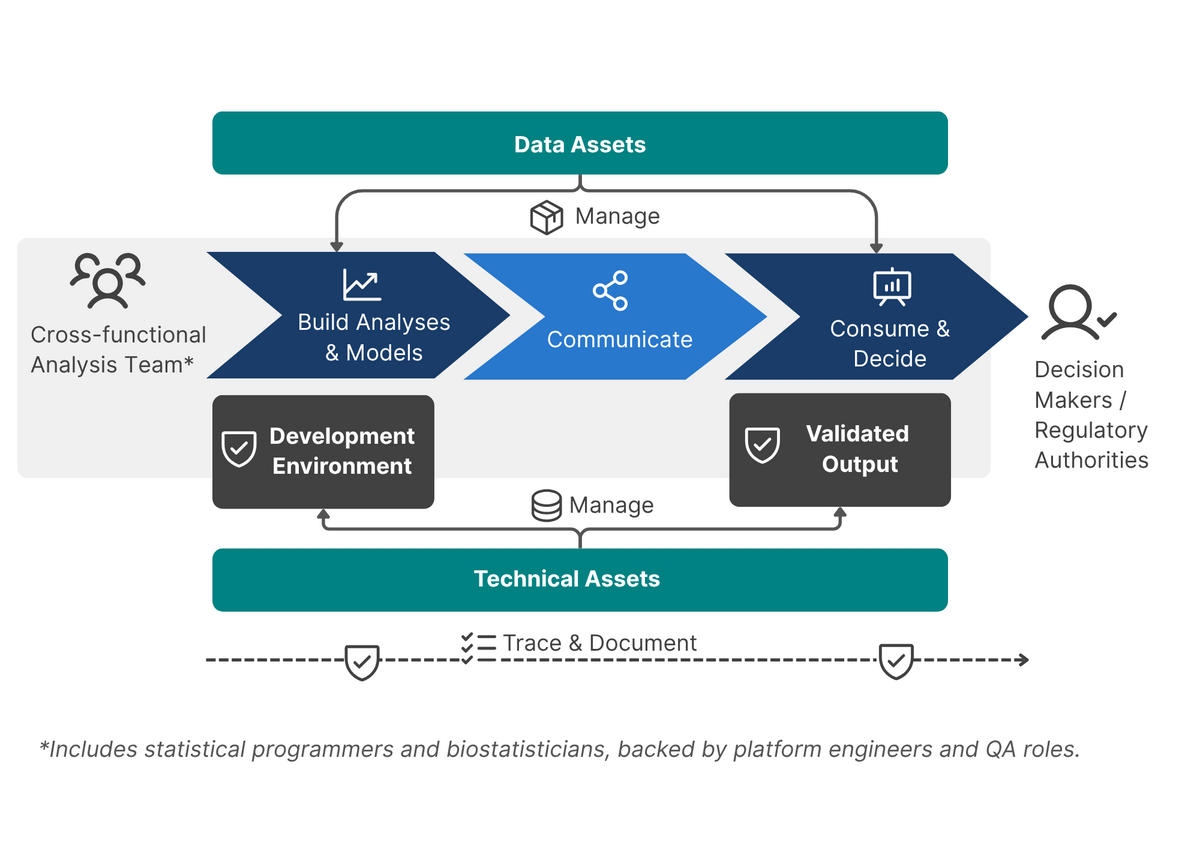
The illustration shows how a modern SCE orchestrates key functional building blocks across teams, tools, and assets. Each component contributes to a validated and efficient analytics workflow.
Each core function of a modern Statistical Computing Environment can be strengthened individually or developed incrementally. HMS offers service modules based on these principles that create tangible added value throughout clinical analytics workflows.
Whether you’re starting with a single validated R package or planning a complete platform transformation, HMS supports you in building scalable, compliant, and efficient analytics environments. Our interdisciplinary team combines deep engineering know-how with life sciences expertise and supports you wherever you are on your journey.
Assessment and planning
We analyze existing systems, define objectives, and clarify all relevant validation requirements.
Architectural design
We develop technical and procedural concepts. These include toolchains, infrastructure, and governance models.
Implementation and deployment
We configure the environment, integrate the necessary tools, and set up workflows that comply with regulations.
Validation and documentation
We test, document, and validate the solution in accordance with GAMP principles and CSV standards.
Knowledge transfer and support
We empower your teams through training, documentation, and on-the-job support tailored to their needs.
Our typical process begins with a structured assessment - and that’s exactly how our discussion can begin as well.
Discuss the project situation
Why HMS Is the Right Partner for Validated Clinical Analytics
With HMS, you’re choosing a partner that combines analytical expertise with in-depth technological knowledge and a strong understanding of regulated environments. Our services are modular in design and integrate seamlessly into existing infrastructures.
- Proven in regulated environments
HMS combines deep technological expertise with a clear understanding of the requirements that apply in regulated contexts and how to reliably meet them. - An engineering approach to clinical analytics
We apply proven software engineering principles to clinical analytics workflows. This results in solutions that are reproducible, can be reliably validated, and can be operated stably over the long term. - Technology-independent and domain-focused
Whether you’re a statistical programmer working with Posit, R, SAS, or Python, or whether your IT architecture decisions favor on-premises or cloud-based approaches, we develop solutions that integrate into your existing system landscape and support the specific requirements of your domain. - Experience in life sciences environments
Our clients include global diagnostics and pharmaceutical companies. We understand the requirements, framework conditions, and expectations relevant to the analysis of clinical data.

Cloud-native Statistical Computing Environment für klinische Studien
HMS ersetzte bei Boehringer Ingelheim ein 25 Jahre altes SAS-System durch eine cloud-native Statistical Computing Environment auf AWS. Die Plattform integriert SAS Viya und unterstützt automatisierte Validierung unter GxP-Anforderungen.

Pharmatrends früher erkennen mit KI-gestützter Newsanalyse
Für einen internationalen Pharmakonzern entwickelte HMS eine Plattform, die News analysiert, Themen clustert und Entwicklungen sichtbar macht. So erhalten Fachbereiche eine bessere Grundlage für Marktbeobachtung und Updates.

Planung und Analyse klinischer Studien in einer validierten R-Umgebung bei medac
Für die Auswertung klinischer Studiendaten konzipierte und realisierte HMS eine validierte R-Umgebung im GxP-Umfeld. Kontrollierte Paketstände und versionierter Code unterstützen nachvollziehbare Analysen auf Microsoft Windows.