

What is Agentic AI?
08.07.2025

Senior Data Scientist
Introduction to Agentic AI
“Agentic AI is a framework in which autonomous AI agents independently perform tasks, make decisions, and interact with tools and systems while pursuing a defined goal.” [1]
Differences from Workflows, Benefits for Businesses, and Real-World Examples
Agentic AI is one of the most promising concepts in the field of artificial intelligence, especially for businesses that work with data-driven use cases. But what exactly is it? In this article, we explain how Agentic AI differs from traditional workflows, what benefits it offers, and how businesses can use it effectively.
Agentic AI—Explained Simply: Definition & Principles
Agentic AI is a framework in which autonomous AI agents independently perform tasks, make decisions, and interact with tools and systems while pursuing a defined goal.
Workflows vs. AI Agents
- Workflows follow predefined rules and steps.
Example: If A, then B, then C. - AI agents act autonomously.
They analyze, plan, and act: they choose the next step based on the context and the goal.
Key difference:
Agentic AI is the overarching architecture or the overarching mindset.
AI agents are the operational building blocks within this architecture.
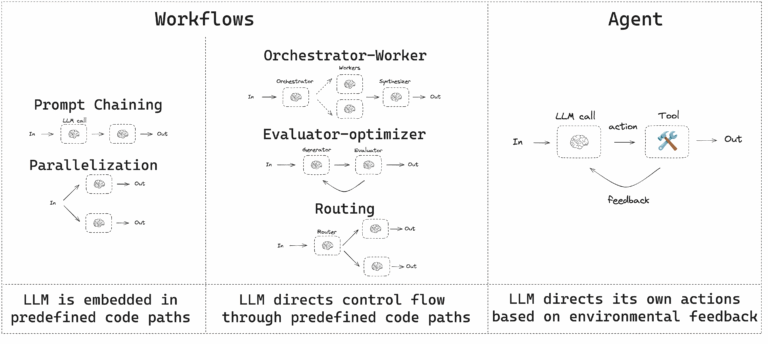
When should agents be used instead of workflows?
Workflows work well when every step is clearly defined and predictable.
However, many business processes are far from that:
- multiple input options
- dynamic context
- unreliable or incomplete data
- Decisions must be made in real time
In these scenarios, autonomous agents realize their full potential:
they offer flexibility and goal-oriented behavior.
What can AI agents do?
Modern AI agents are much more than just chatbots. They
- access tools such as browsers, CRM systems, or databases
- retrieve and analyze information
- weigh decision options
- store past actions (memory component)
- select the next best action and carry it out
Even though the user interface is conversation-based, agents use APIs, cloud infrastructure, or software programs behind the scenes to act intelligently and autonomously.
Benefits of Agentic AI for Businesses
| Benefits | Description |
| Autonomy | Agents do not require a fixed set of rules; they can adapt to the situation and achieve the goal more independently |
| Efficiency | They complete complex tasks more quickly and flexibly |
| Scalability | Once implemented, agents can be used for many different processes |
| Tool Integration | You make intelligent use of existing systems and data |
| Collaboration | Through multi-agent setups, agents can work together in teams |
[3]
Real-World Examples of Agentic AI
Agentic RAG (Retrieval-Augmented Generation)
Unlike traditional RAG (Retrieval-Augmented Generation), which always draws on the same sources, Agentic RAG intelligently adapts to the context of the query.
It autonomously identifies the most relevant data sources and can formulate more complex queries to deliver accurate, actionable answers.
This makes Agentic RAG particularly valuable for:
- Compliance-oriented use cases where varying regulations require adaptive retrieval strategies
- Inquiries from customers or stakeholders that require information to be retrieved from various systems (e.g., CRM, documentation, databases containing regulations)
The key advantage: Agentic RAG does more than just retrieve data.
It evaluates, selects, and refines.
This represents a significant step toward smarter, business-oriented AI support. [4]
- Coding Agents
Example: GitHub Copilot is a coding agent that writes code, comments on pull requests, and resolves issues. [5] - Customer Service Agents
respond to customer inquiries, access CRM data, identify when issues need to be escalated, and can also be used in sales and marketing. [6] - Research Agents
: They analyze studies, websites, or internal documentation fully automatically. This makes them ideal for use in the pharmaceutical industry, in R&D, or for market analysis.
Getting Started with Agentic AI
You already have a specific use case in mind.
Perhaps you want to automate parts of a process, reduce manual work, or make better use of existing data. However, when it comes to implementing Agentic AI in practice, things often become more complex than expected. Questions about system integration, architecture, and long-term feasibility often slow teams down.
Agentic AI was developed to address precisely these kinds of situations.
It allows you to move forward with your work without having to define every detail from the very beginning. It connects to your existing systems and leverages data you already rely on. And it supports your use case in a way that can adapt to changing requirements.
However, it’s important to understand the basic principles before you begin implementation.
In the next few posts, we’ll address specific decisions and common challenges—based on real-world project experience.
You’ll learn what matters in each phase: from evaluating use cases to making technical decisions to delivering stable, scalable results.
Final thought: Agentic AI is the logical next step for data-driven teams
Whether you work in marketing, finance, IT, innovation, or any other data-driven field—if you work with data, you’ll benefit from intelligent, autonomous AI systems.
Agentic AI is more than just a buzzword. Together, we’ll turn it into a robust solution that delivers measurable business value.
From automation to RAG: We’ve developed true GenAI systems that are scalable. Luis brings hands-on experience from previous Agentic AI projects.
In our clients’ use cases, you’ll see what has worked and what hasn’t:
- Automated Market and Competitive Analysis with Agentic AI
- Context-Aware Chatbot: Dynamic Document Search with Agentic AI
Get in touch with us! Our expert, Luis Wirth, will be happy to advise you together with our team!
Sources
[1] Atera Blog (March 19, 2025): 18 Motivational Quotes on Agentic AI
[2] LangChain (Accessed July 8, 2025): LangGraph Workflows Tutorial
[3] IBM Think (February 24, 2025): What Is Agentic AI?
[4] IBM Think Blog: Agentic RAG – How It Works and Why It Matters.
[5] GitHub Blog (May 19, 2025): Meet the New Coding Agent.
[6] ThoughtSpot (May 14, 2025): Examples of Agentic AI.